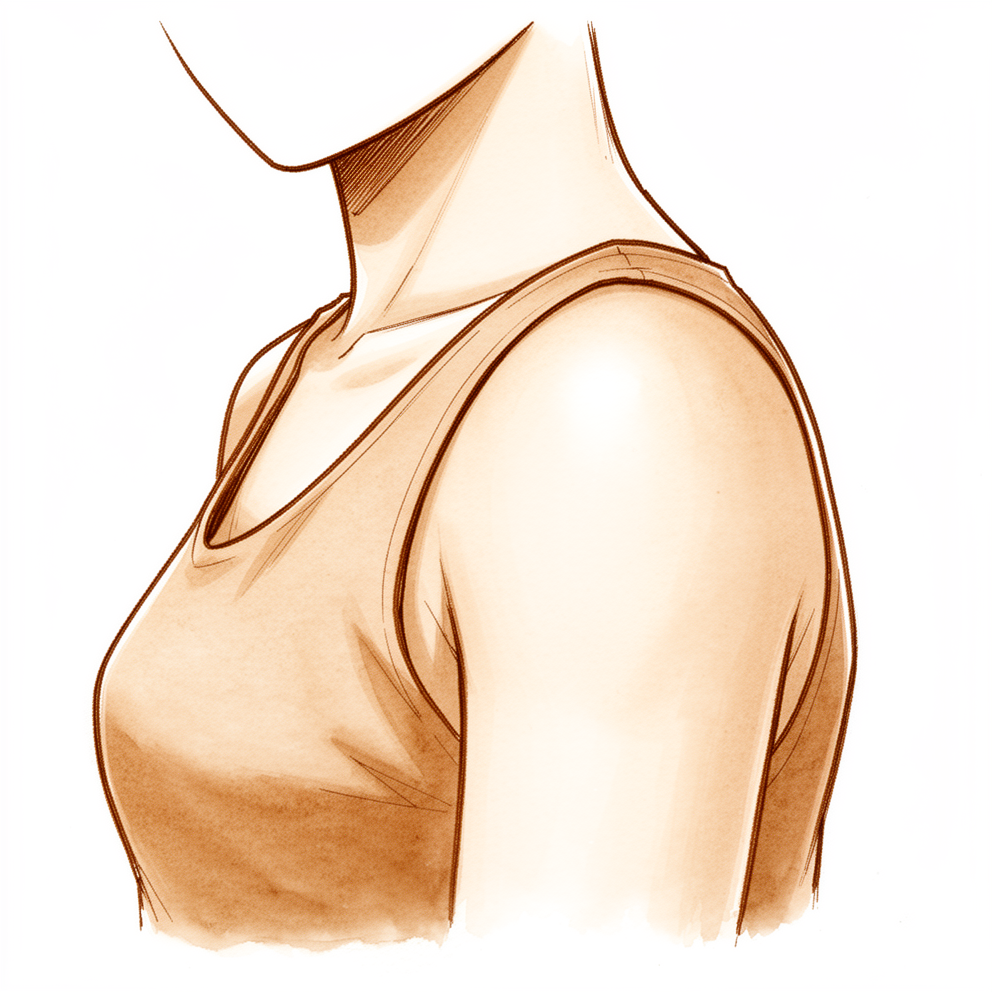
What you're feeling
Snapping scapula means you hear or feel a grating, clicking or snapping sound from your shoulder blade as it moves over your chest wall. Doctors sometimes call it "washboard syndrome", because the sound can feel like a wheel running over a washboard. The noise itself is common. About a third of people with no symptoms at all have some grating from the shoulder blade. On its own, without pain, it needs no treatment.
What usually brings people to see someone is pain. It sits around or under the shoulder blade, often near the inner edge closest to your spine. It tends to worsen with overhead activity, reaching up or across your body, and it can show up as reduced performance at sport. The pain comes from an inflamed bursa, the thin fluid-filled cushion that lets the shoulder blade glide smoothly over the ribs, or from the shape of the bone itself. The chest wall acts like a sound box, so the noise you hear is louder than the movement causing it.
The pain can make everyday tasks hard. Lifting a heavy pan onto a high shelf, hanging washing on a line, or reaching for a seatbelt can all set it off. Some people notice it most after activity rather than during it. It can be severe enough to disturb sleep or stop you using your arm normally.
If your symptoms are not settling, are getting worse over weeks, wake you at night, or stop you working or using your arm, see your GP or ask for a specialist review.
What's actually happening
Your shoulder blade is designed to glide. It sits on your chest wall, separated from it by a thin layer of slippery, fatty tissue that works like a gasket between two moving surfaces. Four joints work together to move your shoulder, and about two-thirds of the movement comes from the ball-and-socket joint itself, with the remaining third coming from the shoulder blade sliding over the ribs. When that glide is smooth, you never notice it.
The problem in snapping scapula is that something disturbs this glide. Sometimes it is the shape of the bone: the inner edge of the shoulder blade may be angled or curved towards the ribs more than usual, so it sits closer to the chest wall than it should. Sometimes it is a small lump of extra bone on the blade. Often it is the muscles around the blade working unevenly, so the blade does not track smoothly as you move. Any of these can make the blade rub or catch instead of gliding.
The rubbing irritates the cushion between the blade and the ribs. That cushion, called a bursa, is a thin fluid-filled sac that works like a shock absorber between bone and soft tissue. When it becomes inflamed it thickens and becomes tender, and that is the pain you feel under or around the shoulder blade. The friction can also cause a reactive thickening of the tissue itself, the body's response to repeated rubbing.
This explains the symptoms described above. The noise comes from the roughened surfaces moving over each other, and the chest wall amplifies it like a sound box. The pain comes from the inflamed cushion, not from the noise itself. That is why the two problems are treated differently, and why treatment focuses on calming the inflammation and retraining the muscles that control the blade.
What we can do about it
Dr Kieran Hirpara, an upper-limb surgeon at Mater Private Hospital Rockhampton, starts with the least invasive options that suit your condition. Patients are generally referred to our clinic by their GP; if a physiotherapist has suggested you see us, you will still need a referral from your GP in order to be eligible for the Medicare rebate. At the clinic, we take a history, examine your shoulder and arrange imaging where it is needed to work out what is causing the noise and the pain.
Most people settle without an operation, so treatment starts without surgery. The first step is a physiotherapy programme to strengthen the muscles that control your shoulder blade, along with stretching of muscles that have become tight. Changing the activities that bring the symptoms on also helps. Give this a proper trial of 3 to 6 months before thinking about anything further.
If pain persists, medicine can help settle the inflammation. Anti-inflammatory tablets, the same kind many people take for muscle aches, are part of this stage. We can also offer an image-guided injection of steroid and local anaesthetic into the bursa under your shoulder blade. This does two jobs: it calms the inflamed cushion, and it confirms that this is where your pain is coming from.
Surgery is considered only when pain continues after several months of these treatments and they have not given you enough improvement. The operation is keyhole surgery, done through small cuts with a camera. It removes the inflamed bursa between your shoulder blade and your ribs. The upper inner corner of your shoulder blade is trimmed only if it is found to be prominent during the operation. Most people's pain improves substantially after surgery, but some clicking often remains. We will talk through what surgery could mean for you and decide together whether it is the right step.
What to expect
Most people settle without an operation. Treatment starts with physiotherapy to strengthen the muscles that control your shoulder blade, anti-inflammatory medicine and changing the activities that bring the symptoms on. Give this a proper trial of 3 to 6 months. Many people find their pain eases over this time and never need surgery.
If pain continues after several months of these treatments, surgery may be considered. Keyhole surgery removes the inflamed bursa between your shoulder blade and your ribs, and trims the upper inner corner of the blade only if it is found to be prominent. Most people's pain improves substantially after surgery. Some clicking often remains, because the treatments that help pain mostly fix the pain, not the noise. Complete relief of every symptom is not the usual result.
Without treatment, symptoms can persist and may be severe enough to disturb sleep or stop you using your arm normally. The condition can be difficult to recognise and treat, so it is worth getting a clear diagnosis early rather than waiting for it to settle on its own.
If your symptoms are not settling, are getting worse over weeks, wake you at night, or stop you working or using your arm, see your GP or ask for a specialist review.
When to see someone
The noise alone is not a reason to worry. About a third of people with no symptoms at all have some grating from the shoulder blade, and on its own it needs no treatment. What matters is pain. See your GP or ask for a specialist review if you have pain around or under the shoulder blade that is not settling, is getting worse over weeks, wakes you at night, or stops you working or using your arm. Also ask for a review if the pain is severe enough to disturb sleep, if your performance at sport has dropped, or if overhead activity such as reaching up or across your body brings the pain on. Snapping scapula can be hard to recognise, so a clear diagnosis early is worth having.
In more depth
Advanced reading: the deeper science (optional)
This section goes further than you need for your own treatment decisions. Snapping scapula is worth the extra reading because the noise and the pain are two different problems, and the treatments that help mostly fix the second one, not the first.
The noise is common; the pain is the problem
Grating from the shoulder blade is not, on its own, a sign of disease. A classic review of the condition cites an early study that found scapular crepitus in 31% of 100 people with no symptoms at all [1]. What turns the noise into a condition is pain, usually from an inflamed bursa: the thin, fluid-lined layer of tissue that lets the shoulder blade glide over the ribs.
Shape plays a part. In an imaging study, people with a scapula that curves forward along its inner border (a concave shape with a positive "medial scapula corpus angle") had a 12-fold higher risk of snapping scapula [2]. That measurement turned out to be less useful than it first looked: a later study found that the same angle varies considerably with the direction it is viewed from, so it is not reliable enough to diagnose the condition on its own [3]. In a cadaver model, the most important bony feature was how far the inner part of the scapula sat forward towards the ribs [4].
Most people settle without an operation
In a series of 30 shoulder blades in 28 patients treated with a specific muscle-strengthening programme, 14 (50%) did well with the exercises alone and 6 (21%) needed only anti-inflammatory medicine as well, so 71% reached a good result or better on the study's own grading without surgery [5].
The longest follow-up comes from Finland. Twelve people who had open surgery and 9 who were treated without it were reassessed a mean of 22 years later. Pain with exertion was low in both groups: 0.8 out of 10 after surgery and 1.5 out of 10 without it, a difference too small to be sure was real (p = 0.357) [6]. Pain improved promptly after surgery in 7 of 12, but in the long run both routes ended in much the same place.
An injection of local anaesthetic and steroid into the bursa does two jobs: it treats the inflammation and it tests whether the bursa is really the source of the pain. In one UK pathway, 74 of 94 patients were still troubled after physiotherapy and had an ultrasound-guided injection; 55 had a good initial response, which lasted in 17 [7]. Among the 42 operated patients who were followed up, those who had responded well to the injection improved more after the operation than those who had not [7]. A larger American series followed for at least five years did not find the same link [8], so a poor response to an injection does not rule surgery out.
What surgery achieves, and what it does not
The largest long-term series followed 66 people for 5 to 15 years after keyhole removal of the bursa and trimming of the corner of the shoulder blade. The average shoulder score rose from 56.7 to 87.2 out of 100, pain fell from 5.2 to 1.4 out of 10, and 77.6% reached an improvement large enough to notice. Of the 42 who played sport, 38 (90.5%) went back to it and 31 (73.8%) returned at or close to their previous level. Eight (12.1%) needed a further operation [8]. Another series of 74 shoulder blades had a similar rate of further surgery (8 of 74) and found that older patients, people who had had symptoms for longer, and people with lower scores for mental wellbeing before surgery tended to do less well [9].
Complete resolution is the exception. A systematic review of 203 operated shoulders found 42 (20.7%) were completely better, 139 (68.5%) were improved but still had some symptoms, and 22 (10.8%) had a poor result [10]. A 2026 review of 464 patients reached the same overall conclusion: both non-operative and surgical treatment relieve pain, but the mechanical symptoms, the clicking and grating, often do not go away completely [11].
Is the bone worth removing?
Trimming the upper inner corner of the shoulder blade is the traditional part of the operation, so it is a surprise that it may add little. One centre compared 24 people who had the bursa removed alone with 32 who also had the corner trimmed. Final pain scores (3.4 and 2.8 out of 10, p = 0.351) and shoulder scores (75.8 and 76.5, p = 0.895) were the same, and clicking was still present in 58% and 59% [12]. The operation was shorter without the bone work: 37.5 against 61.2 minutes [12]. The groups were followed for different lengths of time and were not randomised, so this is not the last word, but it is why the decision to trim the bone is made during the operation rather than in advance.
References for the advanced reading
- Kuhn JE, Plancher KD, Hawkins RJ. Symptomatic Scapulothoracic Crepitus and Bursitis. J Am Acad Orthop Surg. 1998;6(5):267-73.
- Spiegl UJ, Petri M, Smith SW, Ho CP, Millett PJ. Association between scapula bony morphology and snapping scapula syndrome. J Shoulder Elbow Surg. 2015;24(8):1289-95.
- Percin B, Featherall J, Tashjian RZ, Chalmers PN, Joyce CD, Mortensen AJ, et al. The influence of scapular orientation on the medial scapula corpus angle in snapping scapula syndrome. JSES Int. 2025;9(1):70-8.
- Tahal DS, Katthagen JC, Marchetti DC, Mikula JD, Montgomery SR, Brady A, et al. A Cadaveric Model Evaluating the Influence of Bony Anatomy and the Effectiveness of Partial Scapulectomy on Decompression of the Scapulothoracic Space in Snapping Scapula Syndrome. Am J Sports Med. 2017;45(6):1276-82.
- Groh G, Simoni M, Allen T, Dwyer T, Heckman M, Rockwood C. Treatment of snapping scapula with a periscapular muscle strengthening program. J Shoulder Elbow Surg. 1996;5(2):S6.
- Vastamäki M, Vastamäki H. Open Surgical Treatment for Snapping Scapula Provides Durable Pain Relief, but so Does Nonsurgical Treatment. Clin Orthop Relat Res. 2016;474(3):799-805.
- Tytherleigh-Strong G, Gill J, Griffiths E, Al-Hadithy N. Prognosis After Arthroscopic Superior Medial Scapuloplasty for Snapping Scapula Syndrome Improves After a Transient Beneficial Response With an Ultrasound-Guided Subscapular Cortisone Injection. Arthroscopy. 2020;36(12):2965-72.
- Rupp M, Geissbuhler AR, Rutledge JC, Amendola R, Hanson JA, Doan KC, et al. Minimum 5-Year Clinical and Return-to-Sport Outcomes After Primary Arthroscopic Scapulothoracic Bursectomy and Partial Scapulectomy for Snapping Scapula Syndrome. Am J Sports Med. 2024;52(6):1449-56.
- Menge TJ, Horan MP, Tahal DS, Mitchell JJ, Katthagen JC, Millett PJ. Arthroscopic Treatment of Snapping Scapula Syndrome: Outcomes at Minimum of 2 Years. Arthroscopy. 2016;33(4):726-32.
- Memon M, Kay J, Simunovic N, Ayeni OR. Arthroscopic management of snapping scapula syndrome improves pain and functional outcomes, although a high rate of residual symptoms has been reported. Knee Surg Sports Traumatol Arthrosc. 2017;26(1):221-39.
- Wallace K, Mitchell JK, Lauck BJ, Reed J, Conlon S, Kamath GV. Snapping Scapula Syndrome: A Systematic Review of Treatment Options and Outcomes. J Shoulder Elbow Surg. 2026.
- Featherall J, Christensen GV, Mortensen AJ, Wheelwright JC, Chalmers PN, Tashjian RZ. Arthroscopic scapulothoracic bursectomy with and without superomedial angle scapuloplasty: a comparison of patient-reported outcomes. J Shoulder Elbow Surg. 2023;32(9):1945-52.
Evidence & references
This is the clinical evidence summary written for health professionals. It is technical, and it lists the research this page was built from. You do not need to read it to understand your treatment or to make a decision about it.
Overview
- Snapping scapula syndrome is caused by either osseous lesions or scapulothoracic bursitis [3].
- The condition is also referred to as “washboard syndrome” and is attributed to bony and soft tissue abnormalities [9].
- Snapping scapula represents the clinical expression of scapulothoracic impingement due to mechanical factors and/or muscle imbalance [7].
- Osteochondroma of the scapula is a rare entity that may present with snapping scapula syndrome when it alters scapulothoracic mechanics [6].
- Snapping scapula syndrome can be a debilitating disorder [2].
- Diagnosis and management of snapping scapula syndrome remains challenging despite recent advances [1].
- The condition can be difficult to recognize and treat [3].
- Four-dimensional computed tomography scans facilitate preoperative planning by defining pathology and improving assessment of the amount and location of scapular bone and soft tissue causing symptoms [18].
Treatment
- Treatment of patients with snapping scapula syndrome begins with nonoperative methods [5].
- When nonoperative treatment fails, several surgical options exist [5].
- Arthroscopic management of snapping scapula syndrome yields improvement in pain, crepitus, and range of motion in a majority of patients [4].
- Most patients experience residual symptoms following arthroscopic management [4].
- Arthroscopic scapulothoracic treatment provides significant pain relief and functional improvement for painful snapping scapula symptoms not responding to non-surgical treatment modalities [8].
- Arthroscopic treatment for snapping scapula syndrome resulted in significant improvement in pain and function with high patient satisfaction at a mean follow-up of 3.4 years [14].
- Arthroscopic scapuloplasty leads to significant improvement in pain and function in patients with snapping scapula syndrome refractory to conservative treatment [15].
- Arthroscopic surgery is an effective treatment for snapping scapula syndrome in both primary and revision cases, showing significant improvements in all postoperative outcome scores at a mean of 3.4 years [17].
- Arthroscopic resection of the superomedial corner of the scapula is a useful technique in patients whose pain and clicking can be clinically localized and who have failed to respond to conservative measures [19].
- Arthroscopic resection of the medial superior hook formation in combination with partial bursectomy provided good results with significant gains with respect to the WORC score in 90 % of the patients troubled by painful snapping scapula for a long time and without relief by exercise-based rehabilitation [35].
- At the end of 1 year, all patients in a case series had a constant score above 90 and were completely relieved of snapping around the scapula having full pain-free movements at the shoulder and scapulothoracic joints [11].
- A patient remained asymptomatic with full range of motion and no further complaints of pain or snapping at twenty-six months postoperatively [12].
- At 2 years 6 months after the operation, snapping and pain were completely gone and the patient was satisfied with the results [13].
Anatomy & Pathophysiology
Etiology and Mechanism
- Snapping scapula is the clinical expression of scapulothoracic impingement due to mechanical factors and/or muscle imbalance [7].
- The condition is attributed to bony and soft tissue abnormalities [9].
- Osteochondroma of the scapula may present with snapping scapula syndrome when it alters scapulothoracic mechanics [6].
- Subscapular elastofibroma is a reactive pseudotumor resulting from mechanical friction of the scapula on the chest wall [86].
Bony Anatomy and Morphology
- The scapula is separated from the chest wall by thin gliding fibro-fatty tissue, allowing its smooth excursion over the chest wall [53].
- Anterior angulation of the medial scapula in the axial plane was associated with snapping scapula syndrome [34].
- Patients with a concave-shaped scapula and a positive medial scapula corpus angle may be at risk for snapping scapula syndrome [47].
- The anterior offset of the scapula appeared to be the most important bony parameter to consider during preoperative planning and the evaluation of scapulothoracic space decompression with partial scapulectomy [46].
- The weakest area of the circumference of the biomechanical body of the scapula is the connection of the scapular spine and the medial border of the scapula, known as the spinomedial angle [53].
- The superior angle and the adjacent part of the supraspinous fossa form an appendage that serves as a surface of insertion or origin of muscles but does not transmit compressive forces from the glenoid [53].
Soft Tissue and Neurovascular Anatomy
- Neurologic structures around the scapula vary significantly between the neutral arm position and the chicken-wing position commonly used in the arthroscopic treatment of snapping scapula syndrome [85].
- The scapula is attached to the axial skeleton by the clavicle, specifically by the acromioclavicular and sternoclavicular joints [53].
- The scapula serves for attachment of a number of muscles originating from the axial skeleton that control its motion [53].
Classification
- Mauclaire classified scapulothoracic crepitus into three types: froissement (a gentle friction sound thought to be physiologic), frottement (a louder sound with grating, which is usually pathologic), and craquement (a loud snapping sound, which is always pathologic) [26].
- Frottement may suggest a soft-tissue lesion or bursitis, while craquement may suggest an osseous lesion as the source of symptomatic scapulothoracic crepitus [26].
- The snapping scapula syndrome is caused by either osseous lesions or scapulothoracic bursitis [3].
- Snapping scapula is the clinical expression of the scapulothoracic impingement due to mechanical factors and/or muscle imbalance [7].
- The snapping scapula, also called “washboard syndrome,” is a controversial condition attributed to bony and soft tissue abnormalities [9].
- Rib fractures at the posterior angle could cause snapping scapula syndrome [20].
Clinical Presentation
- Snapping scapula syndrome is an uncommon condition that is likely underdiagnosed [42].
- The condition can produce severe shoulder pain and dysfunction [24].
- Patients often present with decreased athletic performance and increased pain with overhead activities [42].
- Crepitus is a reported symptom in patients with snapping scapula syndrome [42].
- High clinical suspicion is necessary in patients presenting with medial scapular border tenderness, palpable crepitus, and audible snapping [40].
- Potential factors causing snapping scapula syndrome include bony prominence at the superomedial scapular angle, imbalance of the periscapular muscles, and scapulothoracic bursitis [42].
- Scapulothoracic crepitus is not necessarily a pathologic condition, as it was found in 31% of 100 normal asymptomatic persons [26].
- Scapulothoracic crepitus is considered pathologic if it is associated with pain, winging, or other disorders of the scapulothoracic articulation [26].
- The condition has been referred to by various names, including snapping scapula, washboard syndrome, scapulothoracic syndrome, rolling scapula, grating scapula, and scapulocostal syndrome [26].
- Mauclaire classified scapulothoracic crepitus into three types: froissement (gentle friction sound), frottement (louder sound with grating), and craquement (loud snapping sound) [26].
- Scapular noises arise from anatomic changes in the tissue interposed between the scapula and the chest wall and/or an incongruent scapulothoracic articulation [26].
- The air-filled thoracic cavity acts as a resonating chamber that amplifies scapulothoracic crepitus [26].
- A mass composed of alternating strands of fatty and fibrous tissue located at the inferior pole of the scapula is pathognomonic for elastofibroma dorsi [36].
- Scapular osteochondroma is a rarely reported cause of scapular pseudo-winging and should be considered in the differential diagnosis when winging and a mass are present [43].
- The differential diagnosis for causes of snapping scapula includes idiopathic causes, scapulothoracic bursitis, osteochondromas, and elastofibromas [42].
- Four-dimensional computed tomography scans facilitate preoperative planning by defining pathology and assessing the amount and location of scapular bone and soft tissue causing symptoms [18].
- Plain radiographs and CT scans provide detailed information about osseous abnormalities in snapping scapula syndrome [42].
- MRI characterizes bursal and other soft-tissue pathologies in snapping scapula syndrome [42].
Investigations
- Symptomatic scapulothoracic crepitus is considered pathologic when associated with pain, winging, or other disorders of the scapulothoracic articulation [26].
- Scapulothoracic crepitus is attributed to anatomic changes in the tissue interposed between the scapula and the chest wall or an incongruent scapulothoracic articulation [26].
- The air-filled thoracic cavity acts as a resonating chamber that amplifies scapulothoracic crepitus noises [26].
- Frottement (a louder sound with grating) usually suggests a soft-tissue lesion or bursitis, while craquement (a loud snapping sound) always suggests an osseous lesion [26].
- Four-dimensional computed tomography (4D CT) scans define pathology well and improve the assessment of the amount and location of scapular bone and soft tissue causing symptoms in snapping scapula syndrome [18].
- Fluoroscopy provides a real-time method for evaluating and documenting abnormal osseous mechanics of the scapulothoracic bursal region [31].
- Anterior angulation of the medial scapula in the axial plane is associated with snapping scapula syndrome [34].
- The anterior offset of the scapula is the most important bony parameter to consider during preoperative planning and evaluation of scapulothoracic space decompression with partial scapulectomy [46].
- Imaging-guided injections provide an alternative means of diagnosis in cases where direct imaging is usually not successful [48].
- Rib fractures at the posterior angle can cause snapping scapula syndrome [20].
Treatment
Non-Operative Management
- In most cases, nonoperative treatment is curative and includes physical therapy for scapular muscle strengthening and nonsteroidal anti-inflammatory medications [29].
- Nonsurgical management remains the first treatment option, with surgery recommended after 6 months of nonsurgical treatment with no improvement [42].
- Nonoperative management of snapping scapula syndrome in the form of analgesia, physiotherapy, local corticosteroid injection, and/or extracorporeal shockwave therapy should be initiated for 3 to 6 months before considering surgical management [40].
- Strengthening weak periscapular muscle groups combined with simultaneous stretching of contracted muscles and training of antagonistic muscle groups can yield good clinical results [42].
- Physical therapy, injections with local anesthetics and/or steroids, and NSAIDs can be useful in nonsurgical management [42].
- Patients treated nonsurgically achieved results that were not distinguishable from the surgically treated group in a small series with a minimum of 16 years follow-up [24].
- At a minimum of 16 years follow-up, patients treated nonsurgically reported little pain, some crepitus (usually painless), and a consistent ability to return to work [24].
Operative Management
- When nonoperative treatment fails, several surgical options exist for snapping scapula syndrome [5].
- Most patients experience residual symptoms after arthroscopic management of snapping scapula syndrome [4].
- For patients who fail conservative management, arthroscopic bursectomy and partial scapulectomy is a reasonable option [23].
- Arthroscopic bursectomy and partial scapulectomy is technically demanding and requires an in-depth understanding of the complex anatomy of the scapulothoracic region [23].
- Improvement in functional outcomes and pain relief are reliably achieved after surgical treatment of snapping scapula syndrome [28].
- Poorer outcomes can be seen in workers' compensation patients as well as those with residual symptomatic shoulder pathology following surgical treatment [28].
- Operative time is shorter without scapuloplasty when performing arthroscopic scapulothoracic bursectomy [30].
- Open surgical treatment for snapping scapula provides durable pain relief [24].
- Patients treated surgically for snapping scapula report little pain, some crepitus (usually painless), and a consistent ability to return to work at a minimum of 16 years follow-up [24].
- At the end of 1 year, all patients in a case series of arthroscopic management for recalcitrant scapulothoracic bursitis had a constant score above 90 and were completely relieved of snapping around the scapula [11].
- Patients in a case series of arthroscopic management for recalcitrant scapulothoracic bursitis had full pain-free movements at the shoulder and scapulothoracic joints at 1 year [11].
- A patient with snapping scapula syndrome remained asymptomatic with full range of motion and no further complaints of pain or snapping at twenty-six months postoperatively [12].
- Snapping and pain were completely gone and the patient was satisfied with the results at 2 years 6 months after operation for abnormal angulation of the superior angle of the scapula [13].
- Arthroscopic access to the scapulothoracic space is simple and reproducible, with bursal tissue clearance optimizing visualization [25].
- Arthroscopic treatment of snapping scapula follows 8 key steps to ensure a safe and effective procedure [10].
- A technique for arthroscopic management of snapping scapula syndrome includes scapulothoracic bursectomy and superomedial partial scapulectomy, which has been refined over nearly two decades of experience [16].
- Most authors have recommended partial scapulectomy or resection of the superomedial angle of the scapula in patients with scapular crepitus and pain caused by bony incongruity [81].
- The decision for and timing of operative management should be individualized for each patient [81].
- Operative options include partial scapulectomy and open versus arthroscopic bursectomy [81].
Complications
- Arthroscopic management of snapping scapula syndrome results in most patients experiencing residual symptoms [4].
- Snapping scapula syndrome is difficult to recognize and treat [3].
Recovery
Non-Operative
- Nonoperative treatment for snapping scapula syndrome includes physical therapy for scapular muscle strengthening and nonsteroidal anti-inflammatory medications [29].
- In most cases, nonoperative treatment is curative [29].
Operative Outcomes
- Improvement in functional outcomes and pain relief are reliably achieved after surgical treatment [28].
- Poorer outcomes can be seen in workers' compensation patients as well as those with residual symptomatic shoulder pathology [28].
- At the end of 1 year, all the patients had a constant score above 90 and were completely relieved of snapping around the scapula having full pain-free movements at the shoulder and scapulothoracic joints [11].
- The patient remained asymptomatic with full range of motion and no further complaints of pain or snapping at twenty-six months postoperatively [12].
- A year after excision, the patient has not suffered recurrent pain in the left shoulder [90].
Surgical Technique and Planning
- Operative time is shorter without scapuloplasty [30].
- The 4D CT scan images defined pathology well in patients with snapping scapula syndrome and improved assessment of the amount and location of the scapular bone and soft tissue causing symptoms [18].
Key Evidence
- [L5] Diagnosis and management of snapping scapula syndrome remains challenging despite recent advances. [1] (10.5435/jaaos-21-04-214)
- [L4] Snapping scapula syndrome can be a debilitating disorder. [2] (10.1016/j.arthro.2012.05.889)
- [L5] The snapping scapula syndrome is caused by either osseous lesions or scapulothoracic bursitis and can be difficult to recognize and treat. [3] (10.1155/2013/635628)
- [L1] Arthroscopic management of snapping scapula syndrome yields improvement in pain, crepitus, and range of motion in a majority of patients; however, most patients experience residual symptoms. [4] (10.1007/s00167-017-4693-5)
- [L5] Treatment of patients with snapping scapula syndrome begins with nonoperative methods; when nonoperative treatment fails, several surgical options exist. [5] (10.1177/0363546504268790)
- [Case_report] Osteochondroma of the scapula is a rare entity that may present with snapping scapula syndrome when it alters scapulothoracic mechanics. [6] (10.1016/j.otsr.2017.01.019)
- [L4] Snapping scapula is the clinical expression of the scapulothoracic impingement due to mechanical factors and/or muscle imbalance. [7] (10.1016/s1058-2746(96)80466-6)
- [L4] Arthroscopic scapulothoracic treatment provides significant pain relief and functional improvement for painful snapping scapula symptoms not responding to non-surgical treatment modalities. [8] (10.2174/1874325001711010785)
- [L5] The snapping scapula, also called “washboard syndrome” is a controversial condition attributed to bony and soft tissue abnormalities. [9] (10.11138/mltj/2013.3.2.080)
- [L5] Arthroscopic treatment of snapping scapula follows 8 key steps to ensure a safe and effective procedure. [10] (10.1016/j.eats.2025.103671)
- [L4] At the end of 1 year, all the patients had a constant score above 90 and were completely relieved of snapping around the scapula having full pain-free movements at the shoulder and scapulothoracic joints. [11] (10.13107/jocr.2025.v15.i02.5290)
- [Case_report] The patient remained asymptomatic with full range of motion and no further complaints of pain or snapping at twenty-six months postoperatively. [12] (10.2106/00004623-198264060-00020)
- [L5] At 2 years 6 months after the operation, snapping and pain were completely gone and the patient was satisfied with the results. [13] (10.1016/s1058-2746(03)00178-2)
- [L3] Arthroscopic treatment for snapping scapula syndrome resulted in significant improvement in pain and function with high patient satisfaction at a mean follow-up of 3.4 years. [14] (10.1177/2325967116s00097)
- [L3] Arthroscopic scapuloplasty leads to significant improvement in pain and function in patients with snapping scapula syndrome refractory to conservative treatment. [15] (10.1016/j.arthro.2020.07.024)
- [L5] This Technical Note presents a technique for arthroscopic management of snapping scapula syndrome that includes scapulothoracic bursectomy and superomedial partial scapulectomy, which has been refined over nearly two decades of experience. [16] (10.1016/j.eats.2022.02.028)
- [L5] The editorial commentary notes that the referenced study by Menge et al. concludes that arthroscopic surgery is an effective treatment for snapping scapula syndrome in both primary and revision cases, showing significant improvements in all postoperative outcome scores at a mean of 3.4 years. [17] (10.1016/j.arthro.2016.11.017)
- [L5] The 4D CT scan images defined pathology well in patients with snapping scapula syndrome and improved assessment of the amount and location of the scapular bone and soft tissue causing symptoms. [18] (10.1016/j.jse.2014.09.020)
- [L4] Arthroscopic resection of the superomedial corner of the scapula is a useful technique in patients whose pain and clicking can be clinically localized and who have failed to respond to conservative measures. [19] (10.1016/s1058-2746(99)90056-3)
- [L5] It should be noted that rib fractures at the posterior angle could cause snapping scapula syndrome. [20] (10.1016/s1058-2746(03)00055-7)
- [Paper] For those patients who fail conservative management, arthroscopic bursectomy and partial scapulectomy is a reasonable option, but is technically demanding and requires an in-depth understanding of the complex anatomy of the scapulothoracic region. [23] (10.1016/j.csm.2014.06.003)
- [L3] [24] (10.1007/s11999-015-4614-1)
- [Paper] Arthroscopic access to the scapulothoracic space is simple and reproducible, with bursal tissue clearance optimizing visualization. [25] (10.1016/j.eats.2015.07.002)
- [L4] [26] (10.5435/00124635-199809000-00001)
- [L4] Improvement in functional outcomes and pain relief are reliably achieved after surgical treatment, although poorer outcomes can be seen in workers' compensation patients as well as those with residual symptomatic shoulder pathology. [28] (10.1177/2325967113505739)
- [L5] In most cases, nonoperative treatment is curative and includes physical therapy for scapular muscle strengthening and nonsteroidal anti-inflammatory medications. [29] (10.1016/j.arthro.2008.12.022)
- [L3] Operative time is shorter without scapuloplasty. [30] (10.1016/j.jse.2023.03.020)
- [L5] Fluoroscopy provides a realtime method of evaluating and documenting abnormal osseous mechanics of the scapulothoracic bursal region. [31] (10.1007/s11420-007-9047-2)
- [L3] Anterior angulation of the medial scapula in the axial plane was associated with SSS. [34] (10.1016/j.jse.2014.12.034)
- [L4] In this study, it was found that arthroscopic resection of the medial superior hook formation in combination with partial bursectomy provided good results with significant gains with respect to the WORC score in 90 % of the patients troubled by painful snapping scapula for a long time and without relief by exercise-based rehabilitation. [35] (10.1007/s00590-012-1154-1)
- [L4] A mass composed of alternating strands of fatty and fibrous tissue is pathognomonic if it is located at the inferior pole of the scapula. [36] (10.1016/j.jbspin.2004.04.006)
- [L4] [40] (10.1177/19417381211029211)
- [Case_report] Scapular osteochondroma is a rarely reported cause of scapular pseudo-winging, and should be considered in the differential diagnosis when winging and a mass are present. [43] (10.1007/s11552-014-9659-1)
- [L5] The anterior offset of the scapula appeared to be the most important bony parameter to consider during preoperative planning and the evaluation of scapulothoracic space decompression with partial scapulectomy. [46] (10.1177/0363546516687755)
- [L3] Those patients with a concave-shaped scapula and a positive MSCA may be at risk for SSS. [47] (10.1177/2325967114s00063)
- [L4] [48] (10.2214/ajr.181.5.1811232)
- [L5] [81] (10.1177/1941738109338359)
- [L5] Neurologic structures around the scapula vary significantly between the neutral arm position and the chicken-wing position commonly used in the arthroscopic treatment of SSS. [85] (10.1016/j.jse.2022.03.029)
- [L4] Subscapular elastofibroma is a reactive pseudotumor resulting from mechanical friction of the scapula on the chest wall. [86] (10.1016/s1058-2746(05)80008-4)
- [L5] A year after excision, the patient has not suffered recurrent pain in the left shoulder. [90] (10.1016/1058-2746(93)90078-u)
References
[1] Snapping Scapula Syndrome: Diagnosis and Management. Journal of the American Academy of Orthopaedic Surgeons. 2013. DOI: 10.5435/jaaos-21-04-214
[2] Technique and Outcomes of Arthroscopic Scapulothoracic Bursectomy and Partial Scapulectomy. Arthroscopy. 2012. DOI: 10.1016/j.arthro.2012.05.889
[3] Scapulothoracic Anatomy and Snapping Scapula Syndrome. Anatomy Research International. 2013. DOI: 10.1155/2013/635628
[4] Arthroscopic management of snapping scapula syndrome improves pain and functional outcomes, although a high rate of residual symptoms has been reported. Knee Surgery, Sports Traumatology, Arthroscopy. 2017. DOI: 10.1007/s00167-017-4693-5
[5] Nonoperative and Operative Management of Snapping Scapula. The American Journal of Sports Medicine. 2004. DOI: 10.1177/0363546504268790
[6] The unusual osteochondroma: A case of snapping scapula syndrome and review of the literature. Orthopaedics & Traumatology: Surgery & Research. 2017. DOI: 10.1016/j.otsr.2017.01.019
[7] Surgical management of snapping scapula. Journal of Shoulder and Elbow Surgery. 1996. DOI: 10.1016/s1058-2746(96)80466-6
[8] Outcome of Scapulothoracic Arthroscopy for Painful Snapping Scapula. The Open Orthopaedics Journal. 2017. DOI: 10.2174/1874325001711010785
[9] Snapping scapula syndrome: current concepts review in conservative and surgical treatment. Muscles, Ligaments and Tendons Journal. 2013. DOI: 10.11138/mltj/2013.3.2.080
[10] Full‐House Arthroscopic Treatment of Snapping Scapula Syndrome: Bursectomy, Levator Scapulae Release, and Partial Scapulectomy. Arthroscopy Techniques. 2025. DOI: 10.1016/j.eats.2025.103671
[11] Arthroscopic Management of Snapping Scapular Syndrome due to Recalcitrant Scapulothoracic Bursitis – A Case Series. Journal of Orthopaedic Case Reports. 2025. DOI: 10.13107/jocr.2025.v15.i02.5290
[12] The snapping scapula syndrome. A case report.. The Journal of Bone & Joint Surgery. 1982. DOI: 10.2106/00004623-198264060-00020
[13] Snapping scapula caused by abnormal angulation of the superior angle of the scapula. Journal of Shoulder and Elbow Surgery. 2004. DOI: 10.1016/s1058-2746(03)00178-2
[14] Two-Year Outcomes following Arthroscopic Treatment for Snapping Scapula Syndrome. Orthopaedic Journal of Sports Medicine. 2016. DOI: 10.1177/2325967116s00097
[15] Prognosis After Arthroscopic Superior Medial Scapuloplasty for Snapping Scapula Syndrome Improves After a Transient Beneficial Response With an Ultrasound‐Guided Subscapular Cortisone Injection. Arthroscopy. 2020. DOI: 10.1016/j.arthro.2020.07.024
[16] Arthroscopic Treatment of Snapping Scapula Syndrome With Scapulothoracic Bursectomy and Partial Scapulectomy. Arthroscopy Techniques. 2022. DOI: 10.1016/j.eats.2022.02.028
[17] Editorial Commentary: Arthroscopy of the Scapulothoracic Joint for Treatment of Snapping Scapula Syndrome—Minimum 2‐Year Results in a Large Series, a Long‐Awaited Publication. Arthroscopy. 2017. DOI: 10.1016/j.arthro.2016.11.017
[18] Four-dimensional computed tomography scans facilitate preoperative planning in snapping scapula syndrome. Journal of Shoulder and Elbow Surgery. 2015. DOI: 10.1016/j.jse.2014.09.020
[19] Arthroscopic partial resection of the scapula for snapping scapula: A new technique. Journal of Shoulder and Elbow Surgery. 1999. DOI: 10.1016/s1058-2746(99)90056-3
[20] Snapping scapula syndrome due to malunion of rib fractures: a case report. Journal of Shoulder and Elbow Surgery. 2004. DOI: 10.1016/s1058-2746(03)00055-7
[23] Snapping Scapula Syndrome in the Military. Clinics in Sports Medicine. 2014. DOI: 10.1016/j.csm.2014.06.003
[24] Open Surgical Treatment for Snapping Scapula Provides Durable Pain Relief, but so Does Nonsurgical Treatment. Clinical Orthopaedics & Related Research. 2016. DOI: 10.1007/s11999-015-4614-1
[25] Arthroscopic Scapulothoracic Decompression for Snapping Scapula Syndrome. Arthroscopy Techniques. 2015. DOI: 10.1016/j.eats.2015.07.002
[26] Symptomatic Scapulothoracic Crepitus and Bursitis. Journal of the American Academy of Orthopaedic Surgeons. 1998. DOI: 10.5435/00124635-199809000-00001
[28] Functional Outcomes After Arthroscopic Scapulothoracic Bursectomy and Partial Superomedial Angle Scapulectomy. Orthopaedic Journal of Sports Medicine. 2013. DOI: 10.1177/2325967113505739
[29] The Snapping Scapula: Diagnosis and Treatment. Arthroscopy. 2009. DOI: 10.1016/j.arthro.2008.12.022
[30] Arthroscopic scapulothoracic bursectomy with and without superomedial angle scapuloplasty: a comparison of patient-reported outcomes. Journal of Shoulder and Elbow Surgery. 2023. DOI: 10.1016/j.jse.2023.03.020
[31] Imaging-Guided Treatment of Scapulothoracic Bursitis. HSS Journal®: The Musculoskeletal Journal of Hospital for Special Surgery. 2007. DOI: 10.1007/s11420-007-9047-2
[34] Association between scapula bony morphology and snapping scapula syndrome. Journal of Shoulder and Elbow Surgery. 2015. DOI: 10.1016/j.jse.2014.12.034
[35] Arthroscopic treatment for snapping scapula: a prospective case series. European Journal of Orthopaedic Surgery & Traumatology. 2013. DOI: 10.1007/s00590-012-1154-1
[36] Imaging study findings in elastofibroma dorsi. Joint Bone Spine. 2004. DOI: 10.1016/j.jbspin.2004.04.006
[40] Diagnosis and Treatment of Snapping Scapula Syndrome: A Scoping Review. Sports Health: A Multidisciplinary Approach. 2021. DOI: 10.1177/19417381211029211
[42] Chapter 5 Adhesive Capsulitis, Cartilage Lesions, Nerve Compression Disorders, and Snapping Scapula. 2019.
[43] Pseudo-Winging of the Scapula Caused by Scapular Osteochondroma: Review of Literature and Case Report. HAND. 2014. DOI: 10.1007/s11552-014-9659-1
[46] A Cadaveric Model Evaluating the Influence of Bony Anatomy and the Effectiveness of Partial Scapulectomy on Decompression of the Scapulothoracic Space in Snapping Scapula Syndrome. The American Journal of Sports Medicine. 2017. DOI: 10.1177/0363546516687755
[47] Significant Association Between Snapping Scapula Syndrome and Anterior Angulation of the Superomedial Scapular Angle. Orthopaedic Journal of Sports Medicine. 2014. DOI: 10.1177/2325967114s00063
[48] Fluoroscopically Guided Scapulothoracic Injections. American Journal of Roentgenology. 2003. DOI: 10.2214/ajr.181.5.1811232
[53] Rockwood And Green S Fractures In Adults. 29: Principles of Nonunion and Bone Defect Treatment > Applied Anatomy Related to Scapular Fractures.
[81] Clinical Management of Scapulothoracic Bursitis and the Snapping Scapula. Sports Health: A Multidisciplinary Approach. 2010. DOI: 10.1177/1941738109338359
[85] Anatomic safe zones for arthroscopic snapping scapula surgery: quantitative anatomy of the superomedial scapula and associated neurovascular structures and the effects of arm positioning on safety. Journal of Shoulder and Elbow Surgery. 2022. DOI: 10.1016/j.jse.2022.03.029
[86] Subscapular elastofibroma: A reactive pseudotumor. Journal of Shoulder and Elbow Surgery. 1996. DOI: 10.1016/s1058-2746(05)80008-4
[90] Snapping scapula: Formation of an erosive, subscapular bursal cyst after partial scapulectomy. Journal of Shoulder and Elbow Surgery. 1993. DOI: 10.1016/1058-2746(93)90078-u